
What Langlade County Deed Records Put on the Record
The Register of Deeds records more than deeds. Mortgages, plats, and certified survey maps are included. UCC filings, articles of incorporation, and revocable trusts sit in the same Langlade County property records system. A deed states that a transfer happened. It does not promise that every earlier interest has surfaced or been resolved. Read the grantor, grantee, legal description, date, and recording reference as one unit. Then compare them against the prior instrument for the same land. Do that before drawing conclusions about title.
| Deed Type | What It Does | Common Use |
|---|---|---|
| Warranty deed | Transfers the interest described and includes the warranties stated in the instrument. | Review the actual covenants and legal description. |
| Quitclaim deed | Conveys whatever interest the grantor holds, without a promise that title is clear. | May appear in family or title-correction transfers. |
| Personal representative deed | Shows a transfer made by an estate representative when recorded. | Read with the probate file and authority documents. |
| Trustee deed | Identifies a transfer by a trustee in the capacity stated. | Check the trust and vesting context where available. |
| Mortgage or lien filing | Records an encumbrance or financing instrument, not a deed transfer. | Check releases and later filings separately. |
Not every filing near a deed works like a deed. A conveyance names the parties who transferred and received. A mortgage or lien records a claim or security interest instead. Check for a later satisfaction or release. Don't assume an older filing still governs the parcel. Langlade County publishes record categories through its public source. But there is no complete online schedule of fields or images.
LandShark Is Langlade County's Public Deed Entry
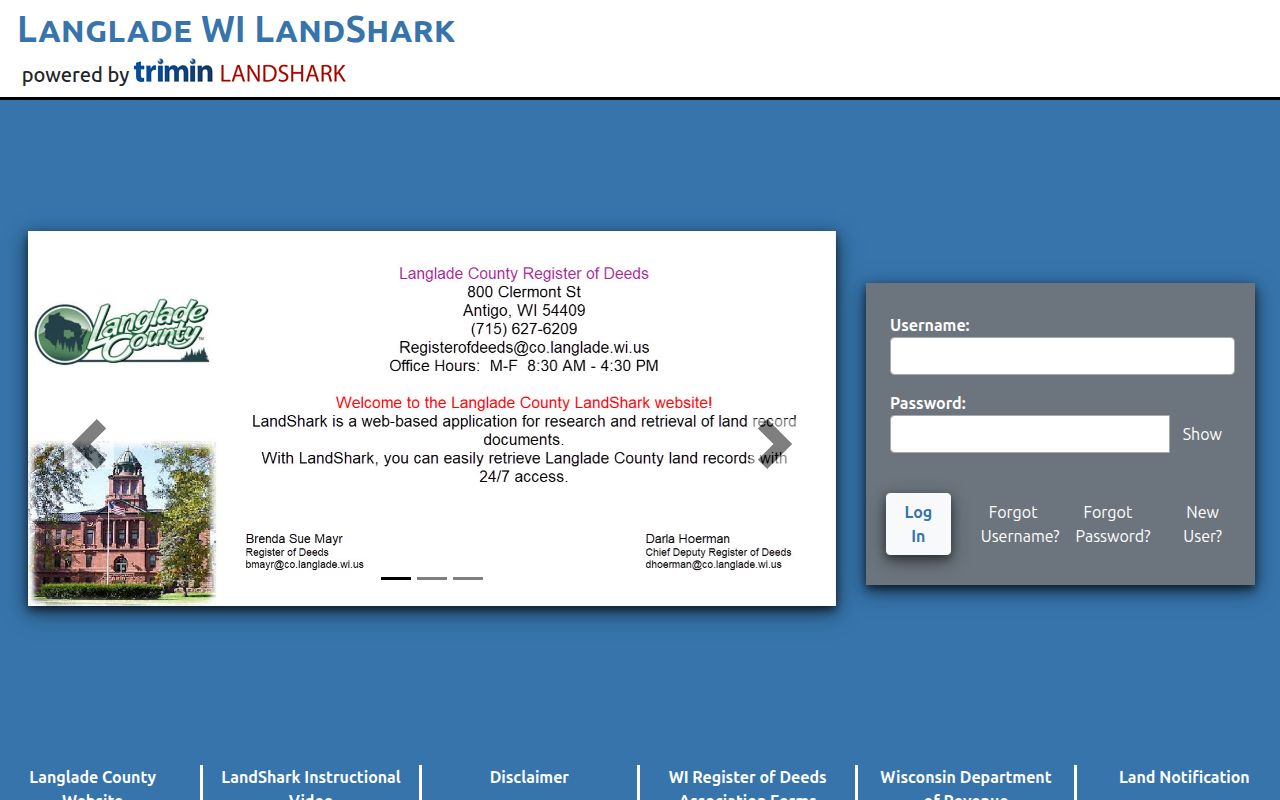
LandShark is the Register of Deeds' online public-access application for Langlade County deed records. The county's office page links to it. The interface runs on JavaScript. The county publishes no plain-text list of its search fields, image gates, or earliest year. Confirm those details in the live system or with staff. Never copy a cutoff date from another county; Langlade's own index sets its range. When a result appears, write down the names, document type, and recording date. Also record the legal description on the screen. Compare the instrument to a second source. Do this before treating it as the transfer for a specific parcel. Older books or images sometimes sit outside the online search. The Register of Deeds can explain which volume or index holds them.
| Portal | Langlade County LandShark public access |
|---|---|
| Search-field labels | Not exposed in the county's text description; verify in the JavaScript application. |
| Online cutoff | Not located in official sources; ask the Register of Deeds. |
| Older material | Request guidance on deed books, indexes or other office-held formats. |
Use the Langlade County LandShark portal for the current recorded-document interface.
Follow the Langlade County Grantor and Grantee Names
Tracing title backward takes patience. Start with the latest known deed. Treat the grantee as the party who received the interest. The grantor on that instrument becomes the next name to check as a grantee on an earlier deed. The legal description anchors everything. Move back one step only when the next instrument describes the same land. It must also explain how it changed. This method can expose a missing link, a parcel division, or a transfer sitting inside an estate or trust within Langlade County property records.
- Find the newest deed that describes the parcel and note its grantee and grantor.
- Search the grantee name to find the instrument by which that party acquired the same land.
- Compare the legal descriptions and note any lot split, consolidation or exception.
- Continue backward until a gap appears, then ask the Register of Deeds about older indexes or books.
- Grantor
- The party named as conveying an interest in the instrument.
- Grantee
- The party named as receiving that interest.
- Chain of title
- The sequence of recorded instruments used to trace title to the parcel.
- Recording reference
- The document's index identifier; use the reference shown by LandShark or the office.
Not Every Recorded Instrument Is a Deed
The Register of Deeds records mortgages, plats, certified survey maps, and UCC filings. It also records articles of incorporation and revocable trusts alongside Langlade County deed records. The broader list matters. A search can return an instrument tied to land without moving ownership at all. A mortgage may explain financing. A certified survey map shows how a parcel was divided. A plat fixes lot and block references. A trust or entity document clarifies how a party holds title. Sort records by function using the instrument title and legal description. A release or satisfaction may retire an older mortgage. A plat or CSM can explain it. A newer deed may cover only part of an earlier parcel. Ask for related documents whenever the main deed cites another instrument. Also ask when its boundary depends on a recorded map.
Estate Transfers Need More Than a Name Match
A death alone does not show how real estate moved. The probate file may identify the personal representative and that person's authority to transfer. Meanwhile, the deed index records the later instrument signed in that role. Compare the representative's name and capacity, the date, the legal description, and the probate case. Never assume a tax-roll change is the title event. Langlade County keeps Register of Deeds records and circuit-court records in separate systems. The Register of Deeds also handles vital records, and access rules differ by record type. A Wisconsin death certificate can support estate research. A probate order or decree, by contrast, lives in a court file. For a divorce after January 1, 2016, the county notes that the Register of Deeds can supply the certificate. The decree itself comes from the Clerk of Courts. Use the right custodian for the document you need.
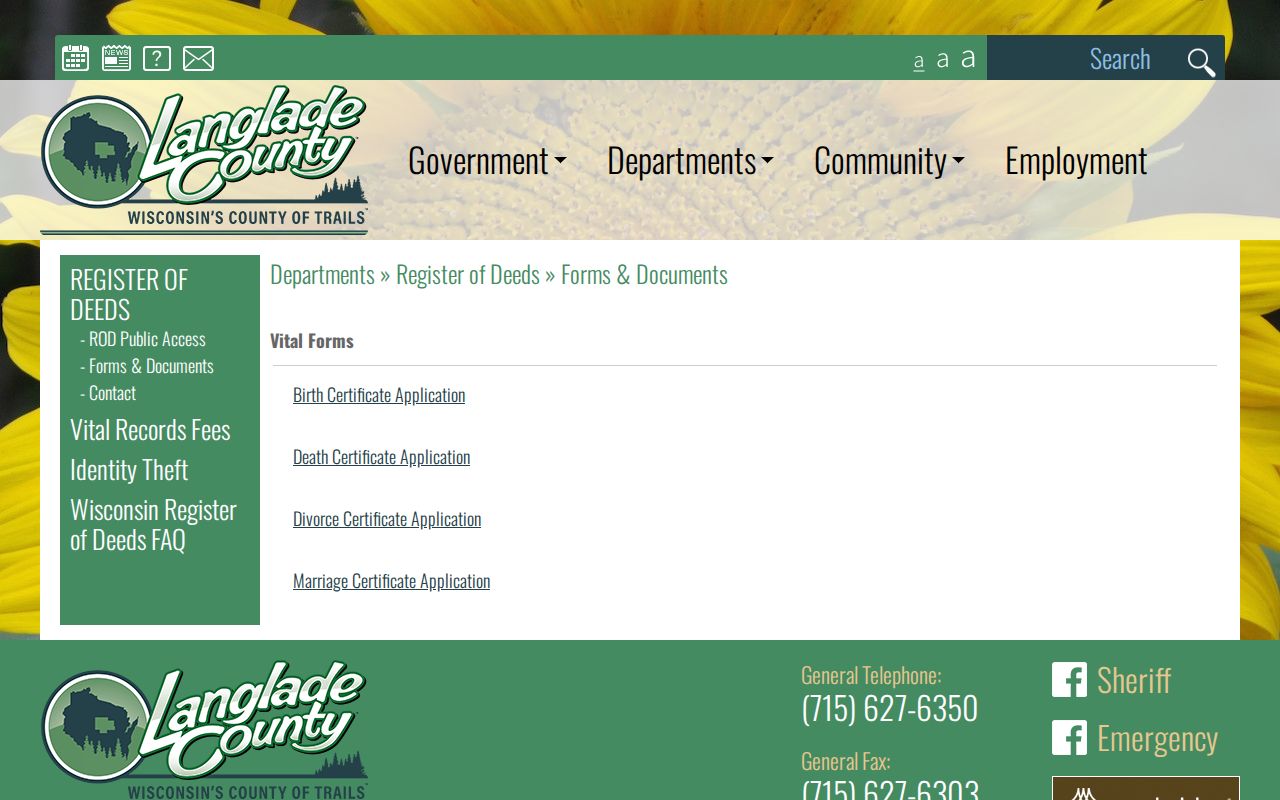
The Register of Deeds provides county vital-record forms and document links separately from its real-estate deed index.
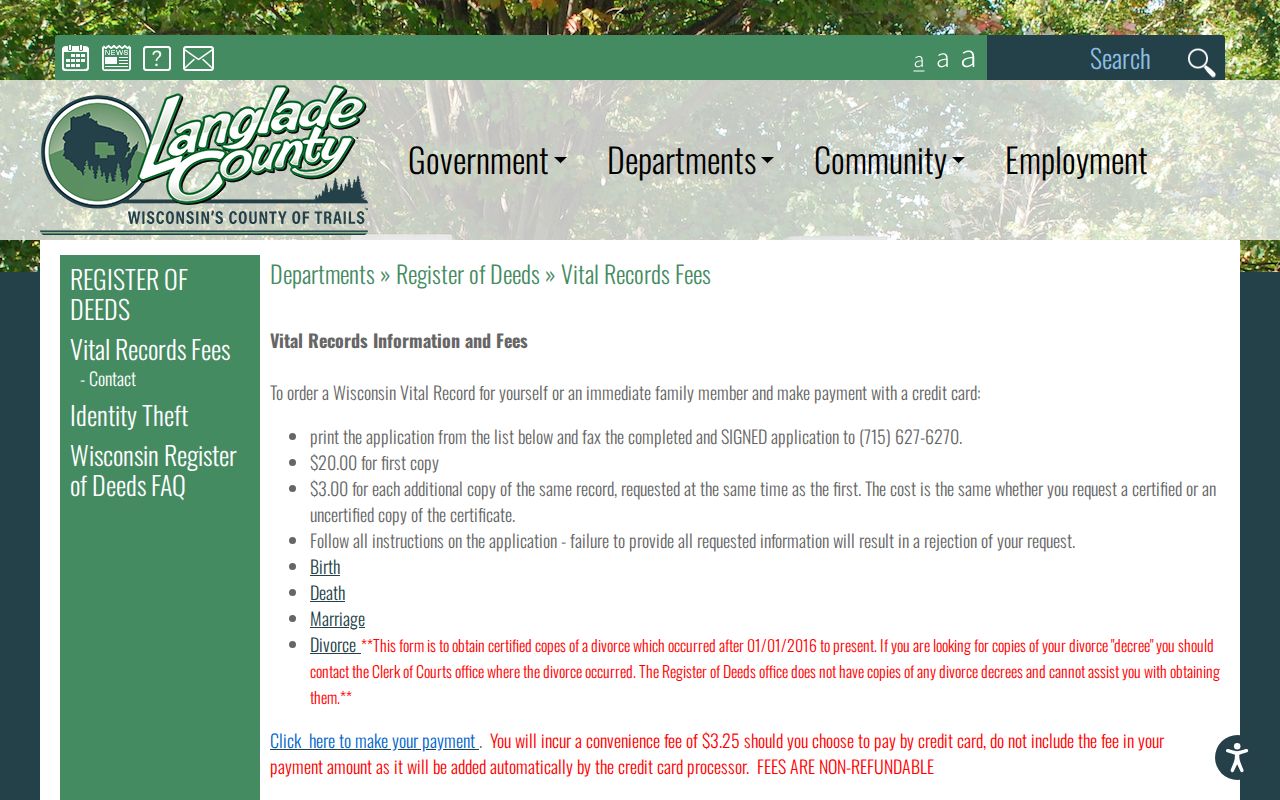
Check the county's vital-record fee and request instructions for local certificate requirements.
Older Langlade County Deed Books Need Confirmation
How far back does LandShark go? The official sources do not say, and they leave unclear whether every older image is online or where web records give way to paper. A recent deed may surface quickly. An older chain can stay hidden. That gap matters. For a long chain, call the Register of Deeds. Give the parcel's legal description, the parties, and the oldest recording reference you have. Staff can point to the deed books, indexes, or microfilm that hold the next step of the property records search. No fee schedule for a real-estate deed copy is published. Ask the office for the current charge and whether a plain or certified copy is available before ordering. The Register of Deeds counter is at 800 Clermont Street, Antigo, WI 54409, telephone 715-627-6209, open Monday through Friday, 8:30 a.m. to 4:30 p.m., closed noon to 1 p.m.
Historic Plats Can Explain a Changed Description
Older map names can unlock Langlade County deed research. The Wisconsin Historical Society's Standard Atlas labels the north and south parts of Antigo, Highland Park, and Reeves. Deerbrook appears there under its plat name, Neva. A modern address may miss an older parcel. When that happens, search the historic plat name and compare its lot-and-block language with the current Beacon parcel and the recorded plat. The 1908 county map helps too. It marks landowners, roads, railroads, schools, churches, and town halls, useful context for where a family or farm once stood.
Old maps and newspaper notices are leads, though. A title chain still has to be built from instruments in the Register of Deeds records. Check a plat or CSM whenever a lot changed shape or name in the property records.
The Wisconsin Historical Society catalogs the Standard Atlas of Langlade County, including historic Antigo map sections.
Request a Langlade County Deed Copy From Its Custodian
Start in LandShark. Search for the instrument and save its recording reference and legal description. When the image or copy is not available online, go to the Register of Deeds counter or use the office's listed channels. Name the grantor, grantee, recording date if known, and the land description. Say whether you want a plain or certified copy. No current real-estate deed-copy fee is posted, and no complete request-by-mail procedure is published. Confirm both before sending payment or personal documents.
The office sits at 800 Clermont Street, Antigo. The telephone number is 715-627-6209. Weekday hours run 8:30 a.m. to 4:30 p.m., with a closure from noon to 1 p.m. Ask staff to confirm the requested volume or image is held there. Ask them to explain any charge or certification step.
A clear request separates the instrument from supporting material. Give the recording reference when LandShark supplies one. Otherwise provide both party names, an approximate date, and the legal description. State your purpose. A plain reproduction suits research; a certified copy suits a formal purpose. Confirm the current fee, remote image condition, and mail-order steps with the office before paying or sending documents. Some records belong to other custodians. For a probate decree, vital certificate, or zoning file, contact that record's separate custodian rather than asking the recorder for it with the deed copy.
Recorded, not guaranteed. The Langlade County deed index shows instruments filed with the recorder, but it is not a title opinion. A complete title review may need additional records and professional judgment.